Fireplace Inspection
Dallas Fort Worth:
Common Mistakes
to Avoid
Most fireplace inspection mistakes happen before a technician ever arrives. Knowing the difference between inspection levels, skipping the sweep, or hiring someone without documented process — these are the errors that turn a routine maintenance call into an expensive repair, or worse, a house fire.
Dallas-Fort Worth Chimney Work Done the Right Way
We have operated in the Dallas-Fort Worth Metroplex since 1991. That is 33 years of chimneys, gas fireplaces, dryer vents, and everything in between. Our 12 active crews cover the full metroplex, from Allen and Frisco to Irving and Carrollton.
Learn more about chimney sweep North Texas in Carrollton →
Every inspection produces a written report. Not a verbal summary, not a handshake. A documented record of what we found, what it means, and what needs attention. That matters for insurance claims, real estate transactions, and your own records.
Our sweeping process uses HEPA containment, so creosote and debris do not end up on your furniture or in your HVAC return. Most inspection and sweep appointments take two to four hours depending on chimney height, fireplace type, and condition.
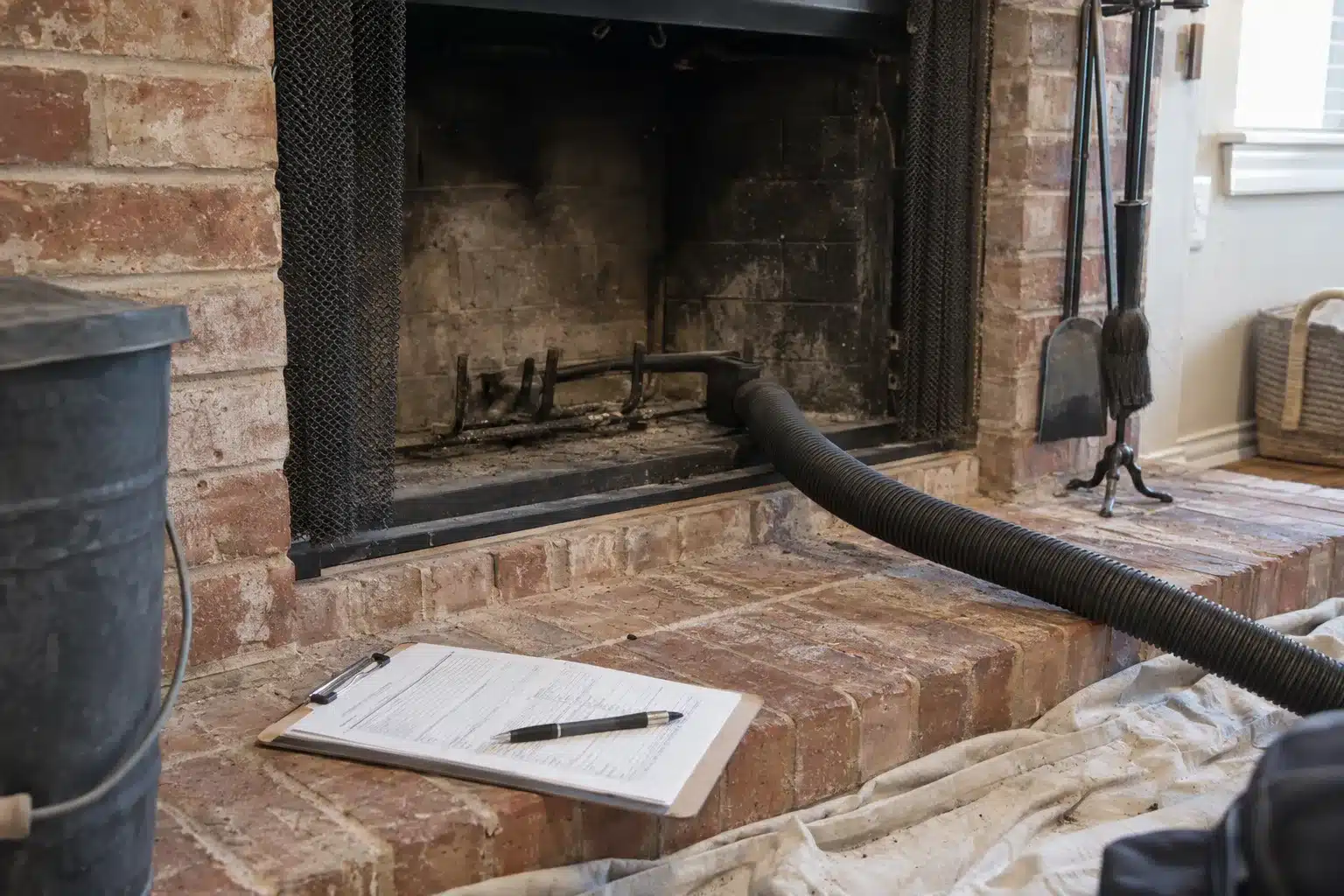
HEPA Containment Sweeping
We use HEPA-rated vacuum systems during every sweep, capturing fine particulate before it circulates through your home. This is the standard for occupied residences, not an upgrade.
Written Inspection Reports
Every appointment includes a documented safety report. Real estate buyers, sellers, and insurance carriers all recognize and accept our written findings as authoritative documentation.
Full Metroplex Coverage
With 12 active crews dispatched across DFW, we service Dallas, Fort Worth, Frisco, Allen, McKinney, Irving, Carrollton, Grapevine, and surrounding communities consistently.
What DFW Homeowners Get Wrong About Fireplace Inspections
These are the actual errors we see repeatedly after 33 years of work in this market. Each one is fixable, but some are more costly to fix after the fact.
Confusing Inspection Levels
The National Fire Protection Association (NFPA) defines three inspection levels, and choosing the wrong one is one of the most common mistakes. A Level 1 inspection covers accessible portions of the chimney interior and exterior during routine annual maintenance. A Level 2 is required any time a property changes ownership, after a chimney fire, or when you change fuel type. A Level 3 involves demolition of structural components when hidden damage is suspected.
A homeowner buying a house who accepts a Level 1 report in place of a Level 2 is leaving significant liability undocumented. Read the full breakdown at Level 1 vs Level 2 vs Level 3 Chimney Inspection: Which One Do You Actually Need?
NFPA Standard 211 →Skipping the Sweep Before Inspection
An inspector cannot see cracks, spalling, or liner damage under a layer of creosote. A third-degree creosote deposit, the glazed black variety that burns at temperatures above 2,000 degrees Fahrenheit, can completely mask deterioration in the firebox and smoke chamber. Scheduling an inspection without a prior sweep means you may get a clean report on a structurally compromised chimney.
Our standard service combines both in one appointment. See how the two services differ at Chimney Inspection vs Chimney Cleaning: What's the Difference?
Treating Gas Fireplaces as Maintenance-Free
Gas fireplaces require annual inspection for carbon monoxide safety, not just wood-burning units. Cracked heat exchangers, failed thermocouples, deteriorating pilot assemblies, and blocked vent pipes are gas-specific failure modes. Carbon monoxide is odorless. By the time you notice something is wrong, the problem has already been present for some time.
If your pilot light is behaving unusually, that is frequently an early indicator of a broader problem. Learn the signs at 3 Signs It's Time for a Gas Fireplace Inspection and Gas Fireplace Inspection Dallas.
Ignoring Mortar and Crown Damage
Dallas summers stress chimney mortar in ways most homeowners do not expect. Temperatures above 100 degrees Fahrenheit, combined with freeze-thaw cycles in winter, cause mortar to crack and shrink. Once water enters through crown gaps or deteriorated mortar joints, it migrates into the firebox, damages the liner, and can rot the framing behind the brick veneer.
Early detection during a routine inspection costs substantially less than a full repair. See current pricing context at Chimney Crown Repair Cost in Dallas (2026 Guide) and What Happens to Dallas Chimney Mortar in Summer Heat.
Waiting Until Something Goes Wrong
Annual inspections exist because deterioration is gradual and mostly invisible. Creosote accumulation of a quarter inch or more in a flue already represents a measurable fire risk, but you will not see it from the fireplace opening. Wasp nests and bird nests in chimney flues are common throughout DFW in spring and summer, and both create combustion hazards and obstructions that are easily missed without a camera inspection.
The U.S. Consumer Product Safety Commission identifies chimneys as a leading source of home fire ignition. Annual inspection is the primary control measure.
Overlooking Refractory Panel Condition
Refractory panels are the cast panels lining the firebox interior. They are rated for high heat, but they crack over time, especially if a fireplace is used regularly or if green wood has been burned. A crack wider than one-sixteenth of an inch typically requires replacement. A technician will probe the surface during inspection because visual cracks alone do not tell the full story.
Homeowners sometimes attempt panel replacement without understanding the fitting requirements or mortar specifications. See the trade-offs at DIY vs Professional Refractory Fireplace Panel Replacement Dallas.
DFW-Specific Conditions That Change the Inspection Calculus
DFW does not have a single climate pattern. North Texas gets hard freezes in winter and sustained heat exceeding 100 degrees in summer. That swing stresses masonry in ways that milder climates do not. Mortar joint deterioration accelerates, and flashing gaps that open during heat contraction let water in during the next rain event.
Spring is the primary season for nest intrusion. Chimney swifts are a federally protected migratory species under the Migratory Bird Treaty Act, which means their nests cannot be removed while they are occupied. We identify active nests during inspection and document them accordingly. Waiting until fall is the only legal option once swifts have settled.
Wasp nests are a separate issue and fully removable. Our crews deal with them regularly from April through October. The nest itself blocks airflow, and an obstruction in a gas flue is a CO risk, not just an inconvenience.
New construction in DFW is another inspection trigger many homeowners miss. Prefabricated fireplaces in homes built since the 1990s have a finite service life on their components. Zero-clearance units are not designed to last indefinitely, and the insulated panels and gaskets inside them degrade on a different schedule than traditional masonry. A first inspection on a 15-year-old prefab is already overdue.
Inspection Checklist: What Gets Documented
- ✓ Firebox condition — refractory panels, mortar joints, damper operation and seating
- ✓ Flue liner integrity — clay tile, stainless steel liner, or cast-in-place, with camera documentation when accessible
- ✓ Creosote classification — first, second, or third degree buildup and the corresponding recommended action
- ✓ Chimney crown and cap — cracking, missing sections, improper pitch, and cap fit
- ✓ Flashing condition — step flashing, counter flashing, and sealant integrity at the roofline
- ✓ Exterior masonry — efflorescence, spalling brick, open mortar joints, visible water infiltration staining
- ✓ Obstruction check — nests, debris, collapsed sections, or foreign objects in the flue
- ✓ Gas appliance specifics — pilot assembly, burner, venting configuration, and CO production indicators where applicable
The Chimney Safety Institute of America (CSIA) publishes standards referenced by our inspection protocol and the inspection report format we provide to clients.
How a Proper Inspection Actually Runs
Here is the sequence we follow on a standard chimney inspection and sweep appointment. Most jobs run two to four hours. Gas fireplace inspections without a masonry flue typically run shorter.
Exterior Review First
We start at the roofline. Cap condition, crown condition, flashing at the chimney base, and the exterior masonry get documented before we go inside. Damage visible from the exterior often tells us what to look for internally.
Interior Setup and Protection
Drop cloths are placed at the fireplace opening. The HEPA vacuum system is connected before any brushing begins. If there is a significant debris load, we assess that before starting the rotary brush system to avoid pushing material through gaps in damaged sections.
Rotary Brush Sweep
The rotary brush system works from bottom to top or top to bottom depending on flue configuration. Creosote is mechanically loosened and captured. Third-degree glazed deposits may require chemical treatment before mechanical removal is possible; we assess this on site and communicate it before proceeding.
Six-Point Safety Review
After the flue is cleared, the six-point safety review covers the firebox, smoke chamber, liner, damper, exterior masonry, and any gas components. Where access permits, a camera is used for liner documentation. Gas fireplaces receive CO safety assessment as part of standard procedure.
Written Report and Walkthrough
Before leaving, the technician walks through the written report findings with the homeowner. Immediate safety concerns are identified as priority items. Maintenance recommendations are categorized separately. You leave with a document, not a verbal summary you have to remember.
Dryer Vent Inspections: The Overlooked Fire Risk
Dryer vent fires are one of the more preventable home fire types. The U.S. Fire Administration estimates roughly 2,900 dryer fires occur annually in the United States. Lint accumulation in the vent duct is the leading cause. In Dallas-area homes with longer duct runs, especially in two-story homes where the laundry is far from the exterior wall, the buildup rate is faster and the risk is higher.
Many homeowners who call us for a chimney inspection add a dryer vent inspection and cleaning to the same appointment. The two services are unrelated mechanically but share the same efficiency argument: identifying and clearing obstructions before they cause a problem costs substantially less than a fire-damage claim. Annual cleaning is a reasonable interval for most households.
Signs Your Dryer Vent Needs Attention
- ● Clothes take more than one cycle to fully dry
- ● The dryer exterior or the clothes feel unusually hot at the end of a cycle
- ● Burning smell during operation
- ● Visible lint around the exterior vent flap
- ● The vent has not been cleaned in more than 12 months
Services We Provide Across the DFW Metroplex
Chimney Inspection Dallas
Level 1, 2, and 3 inspections with written reports for routine maintenance and real estate transactions.
Chimney Cleaning Services
HEPA containment sweeping with rotary brush systems for wood-burning chimneys and fireplace flues.
Gas Fireplace Inspection Dallas
CO safety assessment, pilot assembly check, burner inspection, and vent configuration review for gas units.
Gas Fireplace Repair Dallas
Thermocouple replacement, pilot assembly repair, valve work, and ignition system service.
Chimney Flashing Services
Step flashing, counter flashing, and roofline sealant work to stop water infiltration at the chimney base.
Chimney Liner Installation
Stainless steel liner installation for damaged clay tile flues, relining after fireplace conversion, and new appliance venting.
Allen TX Service
Full chimney and fireplace services for Allen area homeowners.
Frisco Service
Chimney inspection, sweep, and repair for Frisco homes including newer prefabricated fireplace systems.
Fort Worth Service
Chimney and fireplace services across Fort Worth neighborhoods, with same crews serving both sides of the metroplex.
Frequently Asked Questions
How often should a fireplace be inspected in DFW?
Annual inspection is the standard recommendation for any fireplace, wood-burning or gas. In DFW, spring is when we find the most obstruction issues from nests; fall is when most homeowners remember to call before lighting the first fire of the season. Either timing works as long as the inspection happens before regular use.
What is the difference between a chimney inspection and a chimney sweep?
A sweep removes creosote, soot, and debris. An inspection assesses structural and safety condition. For accuracy, the sweep should precede the inspection. We combine both in one appointment by default because inspecting through a dirty flue produces incomplete findings. More detail at Chimney Inspection vs Chimney Cleaning: What's the Difference?
Do gas fireplaces need chimney inspections?
Yes. Gas fireplaces vent combustion gases including carbon monoxide. Blocked vents, cracked heat exchangers, and deteriorating pilot assemblies are all inspection findings that have direct CO safety implications. The inspection protocol differs from a wood-burning chimney inspection but is no less important. See Gas Fireplace Inspection for the specifics.
When do I need a Level 2 chimney inspection?
A Level 2 inspection is required when a property changes hands, after any chimney fire, or when you change the fuel type or add a new appliance. It covers accessible concealed areas of the chimney system and typically includes camera documentation. Real estate transactions in DFW almost always require Level 2. See the full breakdown at Level 2 Chimney Inspection Requirements Explained.
How long does a chimney inspection take?
A combined inspection and sweep for a standard wood-burning chimney takes two to four hours. A gas fireplace inspection without a masonry flue typically runs shorter. Chimneys with significant creosote buildup, access complications, or additional cameras takes additional time. We give an estimated appointment window when booking.
What should I do to prepare for a chimney inspection?
Clear the hearth area of decorative items and ensure the fireplace has not been used for at least 24 hours before the appointment. If you have records of prior inspections or any recent repairs, have those available. Do not attempt to clean the firebox before the appointment; the technician needs to assess the as-used condition.
Fireplace Safety Resources
These are the authoritative standards and safety bodies that define chimney inspection practice in the United States. Their guidelines inform our inspection protocol and the written reports we produce.
Additional Reading
- → Fireplace Safety Tips: Do's and Don'ts
- → How to Identify and Repair Hidden Fireplace Damage
- → Understanding Fireplace Code in Dallas, Texas
- → What Is a Chimney Sweep? What They Do, What It Costs, and How to Choose One in DFW
- → DIY vs Professional Pilot Light Repair Dallas Fireplace: Which Makes Sense?
- → Chimney Waterproofing Cost in Dallas (2026 Guide)
33 Years.
12 Crews.
One Standard.
We have inspected and swept chimneys in Dallas-Fort Worth since 1991. Every appointment includes a written report. Every sweep uses HEPA containment. Schedule a chimney inspection or gas fireplace inspection and know exactly what condition your system is in before the heating season starts.
Chimney Inspection & Cleaning
Combined inspection and HEPA sweep in one appointment. Level 1 through Level 3 available.
Gas Fireplace Inspection Grapevine
CO safety assessment, pilot and burner check, vent configuration review for gas units in Grapevine.
Fireplace Repairman Services
Refractory panel replacement, damper repair, firebox rebuild, and all fireplace repair work across DFW.
© 2026 The Chimney Inspection & Sweep. Dallas-Fort Worth Metroplex. In business since 1991.

Chimney repair is one of our main services.
We also offer a free home fire safety check at every service appointment.
Information
Service Areas
- Dallas
- Plano
- Carrollton
- Irving
- McKinney
- Frisco
- Allen
- Garland
- Richardson
- Addison
- Arlington
© 2024 – 2025 | All Rights reserved by The Chimney Inspection & Sweep
Powered By Rank First Labs