
Refractory Panels Installed by a Crew Reading Dallas Fireboxes Since 1991
From 1970s masonry builds to post-1990 prefab systems – we fit the panel to the firebox.
Refractory Panel Installation in Dallas: Typical price $750 – $1,533
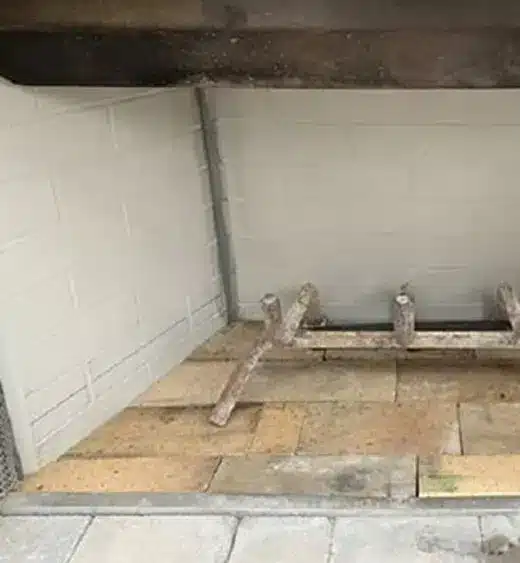
What Refractory Panels Do - and Why Their Condition Decides Whether Your Fireplace Is Safe to Use
Refractory panels are the only layer standing between an open flame and your home’s framing.
A refractory panel is a pre-formed slab made from refractory cement or castable material. It lines the side and rear walls of your firebox – the interior chamber where combustion actually happens. Every fire you build radiates directly against those panels. They absorb the heat. They reflect it back into the burn. And they protect everything behind the firebox wall from temperatures it was never built to handle.
When panels crack or spall – meaning the surface flakes or crumbles due to heat stress or moisture – they stop doing that job. Not all the way, not immediately. But the protection degrades with every fire. The condition of your refractory panels is the single most direct indicator of firebox integrity – the structural and thermal soundness of the interior chamber.
If your panels are compromised, your fireplace isn’t safe to operate. That’s the short answer.
Three Decades of Dallas Fireboxes - From Garland Road Masonry to Irving Prefab Systems
Dallas housing tells a specific story inside every firebox – and we’ve been reading it since 1991.
The older residential corridors along Garland Road and through East Dallas are full of masonry fireplaces built in the 1970s and early 1980s. Those fireboxes have absorbed decades of thermal cycling – the repeated expansion and contraction of refractory material through thousands of heat-and-cool cycles across every season.
Out in Irving and the western suburbs, the story shifts. Homes built after 1985 typically have prefabricated fireplace systems – factory-built units that use manufacturer-specific panels. Those panels cannot accept a generic slab. The replacement piece has to match the original unit model exactly.
Here’s what most homeowners don’t realize about prefab panels: the model information is usually stamped inside the firebox or on a data plate near the damper. We find it before we order anything. We’ve worked across both housing generations in the DFW area. We know which neighborhoods carry which fireplace types – and we come prepared accordingly.
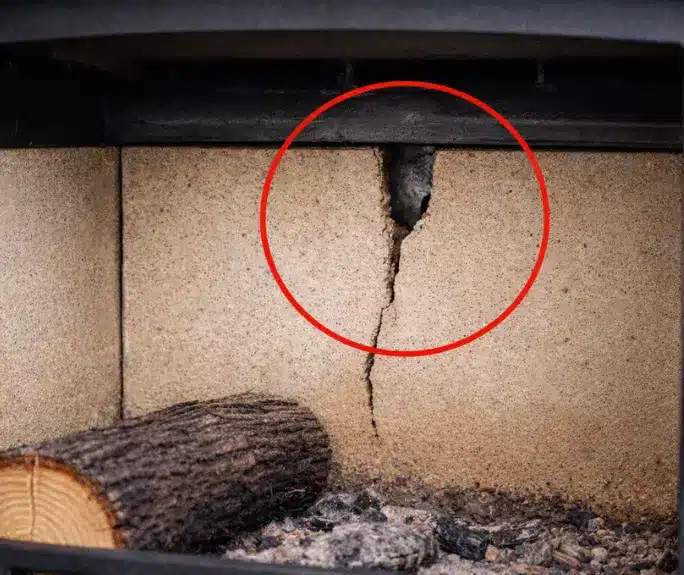
How to Read a Crack: What You're Seeing on the Back Wall of Your Firebox
We’ve looked at thousands of firebox interiors across Dallas – here’s what the cracks are actually telling you.
Homeowners usually notice a crack first on the rear wall of the firebox. It runs vertically, sometimes diagonally. A few are hairline – thin as a pencil mark. Others have opened enough that you can see daylight or feel the difference in texture where the surface has started to separate.
Not every crack is an emergency, and not every crack can wait. The distinction matters. Hairline cracks on the face of a panel that haven’t penetrated through the full thickness are typically surface stress lines. They form during the first few seasons of use as the refractory material settles under thermal load. We see this constantly in homes along the Richardson and Carrollton corridors where fireplaces get used hard through December and January, then sit cold for eight months.
What we’re looking for beyond that is a through-crack – a separation that goes all the way through the panel thickness. We’re also watching for panel spalling, where the surface isn’t just cracked but actually fragmenting. And we’re checking seam gaps: the joints between adjacent panels should be tight. When they open, the gap allows heat to migrate toward the masonry shell or metal firebox housing behind the panel.
On prefabricated fireplace systems, a damaged panel is more urgent. Those units are engineered with specific tolerances. Running the fireplace with a failed panel in a prefab system voids the manufacturer clearances entirely. We photograph the firebox interior before we touch anything
Every Panel We Install Is Measured On-Site and Fitted to Your Firebox Before the Job Begins
We don’t order panels until we have your firebox dimensions confirmed on-site.
Refractory panels are not universal. A panel that’s a quarter-inch too narrow leaves a gap at the seam. That gap is exactly where heat travels when you want it stopped. Seam precision isn’t a detail – it’s the entire point of the installation.
Before any panel is ordered, a technician visits your home in Dallas and measures the firebox opening directly. We record the height, width, and depth of each panel position. For prefabricated fireplace systems, we identify the unit model and confirm the manufacturer-specified replacement panel – because those units require an exact match, not an approximation.
We also confirm NFPA 211 clearance requirements – the National Fire Protection Association standard that governs firebox lining materials and minimum clearances. That confirmation is documented before the job closes.
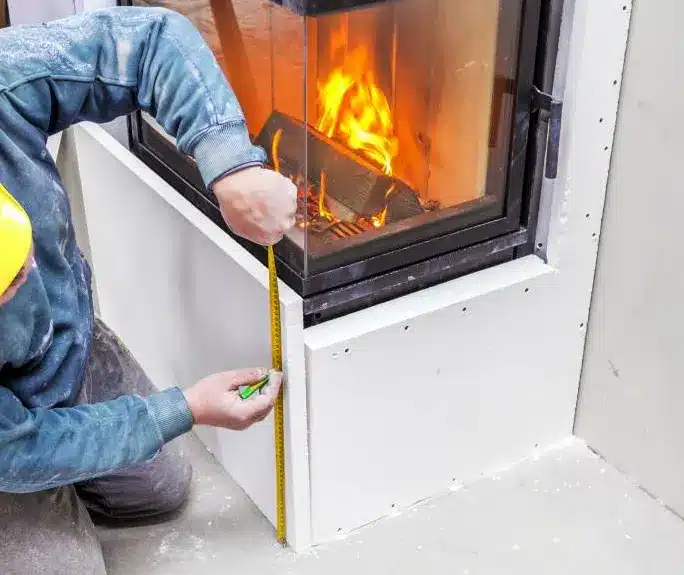
Inside the Installation: Removal, Sizing, Fitting, and NFPA 211 Clearance Confirmation
Diagnostics
The technician inspects the firebox interior with direct lighting. We photograph every visible crack, area of spalling, and open seam. For prefab systems, we locate the data plate. Panel thickness is checked – deteriorated panels sometimes compress unevenly under thermal stress, which affects how replacement panels seat against the firebox floor or surrounding masonry. We also check the smoke shelf and damper area above the firebox. Panel failure sometimes corresponds with draft issues. We note it if we see it.
Implementation
Old panels come out in sequence. Side walls first, then the rear wall. The firebox surface behind the panels is cleaned and checked for damage to the underlying masonry or metal shell. Replacement panels are dry-fit first. Every seam is checked for gap before anything is set. On masonry fireboxes, panels are secured with refractory mortar rated for sustained high-temperature exposure. On prefab units, we follow manufacturer installation procedures specific to that unit model. Seam joints are finished with refractory mortar appropriate to the panel material and firebox type.
Post-Service Confirmation
We photograph the completed installation from the same angles as the pre-work photos. NFPA 211 clearance requirements are confirmed and documented. The homeowner is walked through what was installed, what was removed, and what the firebox interior looks like now. No surprises on the way out the door.
Pricing
Fireplace Panel Installation Cost in Dallas
Typical price ranges for fireplace panel installation across Dallas and the DFW Metroplex. Smaller, simpler jobs sit at the low end.
| Service | Typical price |
|---|---|
| Refractory panelsReplace and install | $750 – $1,533 |
| Firebox high-heat mortar and joint sealing | $329 – $525 |
| Firebox renovation and paint | $680 – $1,200 |
Your exact price is confirmed on site before any work starts. Smaller, simpler jobs sit at the low end of each range. Our $79 chimney safety inspection is waived when you book the repair.
Fireplace Panel Installation Across Dallas, Plano, Carrollton, McKinney, and the Full DFW Metroplex
We run 12 active crews across the full Dallas-Fort Worth service area. We serve Dallas, Plano, Carrollton, Irving, McKinney, Frisco, Allen, Garland, Richardson, Addison, Arlington, and surrounding DFW communities. Neighborhoods along Garland Road, through East Dallas, and across the older residential corridors in Richardson and Carrollton are areas we visit regularly for panel work. Same-week scheduling is available in most of our service area.
Ready to Schedule Your Firebox Panel Assessment in Dallas?
Call us, and we’ll get a technician out to measure your firebox directly. The Chimney Inspection & Sweep has been assessing and replacing firebox panels across Dallas since 1991. More than 850 verified reviews reflect the work. Call 972-884-5553 or email info@theonechimneysweep.com to schedule your on-site panel assessment. Same-week appointments are available across DFW.
FAQ
How much does fireplace panel replacement cost in Dallas?
Call 972-884-5553 for current rates. Cost depends on panel count, firebox type (masonry vs. prefab), and whether the unit model requires manufacturer-specified panels. On-site measurement happens before any panel is ordered – so you’re quoted for what your firebox actually needs, not a generic estimate.
Can I keep using my fireplace if the refractory panels are cracked?
Hairline surface cracks may not require immediate shutdown – but through-cracks do. A through-crack is a separation that goes all the way through the panel thickness. At that point, the panel no longer fully protects the framing and masonry behind the firebox wall. Operating with a compromised panel accelerates damage to the surrounding structure. Don’t assume a crack is surface-level without a technician confirming the depth.
How long does a fireplace panel replacement take from first visit to finished installation?
Most panel replacements are completed in a single visit once the correct panels are on hand. The first visit covers on-site measurement and, for prefab systems, model identification. Panel sourcing follows. Installation typically runs two to three hours. A dry-fit check before any mortar is applied adds time – but it catches gaps before they’re sealed in permanently.
How do I know if my fireplace has prefab panels or masonry panels - and does it matter?
Prefab fireplaces use manufacturer-specific replacement panels that cannot accept a generic slab. Masonry fireplaces use panels cut to dimension. The distinction matters for sourcing – wrong panel type means gaps at the seams. Your technician identifies the system type at the start of every visit. On prefab units, the model number is located on a data plate near the damper or stamped inside the firebox.

Chimney repair is one of our main services.
We also offer a free home fire safety check at every service appointment.
Information
Service Areas
- Dallas
- Plano
- Carrollton
- Irving
- McKinney
- Frisco
- Allen
- Garland
- Richardson
- Addison
- Arlington
© 2024 – 2025 | All Rights reserved by The Chimney Inspection & Sweep
Powered By Rank First Labs