
Dallas Chimney Brick Repair Diagnosed With Thermal Imaging First
We locate subsurface moisture before a single brick is touched.
Chimney Brick Repair in Dallas: Typical price $1,443 – $4,588

What Dallas Homeowners Are Actually Seeing When Bricks Start to Fail
Loose brick material on your roof or in your yard means the chimney masonry is actively shedding.
You might notice it after a storm. A few chips near the base. A section of brick face that looks sunken or hollow. White chalky staining – called efflorescence – streaking down the chimney exterior. These are the first visible signs that water has already moved through the masonry wall.
Here’s what spalling brick tells you: the material on the ground is not the whole problem. Spalling brick – a brick that has shed its outer surface layer due to moisture pressure – is evidence of a process that started inside the wall months or years earlier. The visible damage trails the actual damage by a season or more.
Chimney masonry fails from the outside in. Mortar joints – the thin beds of mortar between each brick course – are designed to absorb movement and moisture before the bricks themselves degrade. When those joints open up, water finds a path. It soaks into the brick. Dallas winters are mild, but January and February still deliver enough freeze-thaw cycles to push that moisture outward with enough force to pop the brick face clean off.
That’s spalling. And once it starts, it moves faster each season.
Three Decades of Chimney Masonry Work Across Dallas's Oldest Neighborhoods
The Chimney Inspection & Sweep has worked Dallas chimneys since 1991 – including the ones that sit on the most demanding clay soil in the region.
Dallas is built on expansive clay soil. That soil swells when it rains and shrinks when it dries out. In North Texas, that cycle happens multiple times per year. The chimney sits on the same foundation as the house, so when the ground shifts, the masonry shifts with it. Over time, small gaps open in the mortar joints. Water enters. Damage spreads.
We’ve repaired brick chimneys in neighborhoods near White Rock Lake, where older masonry construction is most common. We cover the north Dallas corridor toward the LBJ Freeway, where mid-century homes are hitting the age when brick repair becomes necessary. Richardson, Garland, Carrollton, Irving – all carry heavy concentrations of pre-1985 masonry chimneys now showing clay-soil stress patterns.
Our 12 active crews mean assessments aren’t routed through a single technician with a two-week wait. More than 850 verified reviews across platforms reflect the volume of work completed across this market.

Your Repair Covers the Failure Zone, Not Just the Visible Surface
Every brick repair we do is scoped to the actual damage boundary – not just the material that’s already gone.
A common question: “Can you just replace the bricks that fell off?” We replace the bricks that failed, and we address the conditions that caused them to fail.
That means repointing – removing deteriorated mortar from the joints to a set depth and packing in fresh mortar that matches the original mix – happens alongside any brick replacement. Mortar hardness matters here. Dallas masonry from the mid-century era used a softer mortar formulation. Installing modern high-Portland mortar into an older chimney creates a rigidity mismatch. The new mortar won’t flex with clay soil movement, and the surrounding original bricks take the stress instead. We match the mortar to the existing chimney.
After brick replacement and repointing, we seal the repaired surface with a penetrating water repellent rated for masonry. It allows vapor to escape while blocking liquid water entry – the difference between a coating that traps moisture and one that lets the wall breathe.

How We Stage Every Brick Repair - From First Image to Final Seal
Every chimney brick repair follows a staged process – imaging, scoping, replacement, mortar matching, and sealing.
Before a single repair decision is made, we have the full damage picture.
- Thermal imaging scan – identifies cold spots indicating subsurface moisture in the brick and mortar
- Brick course assessment – determines which courses are structurally compromised versus cosmetically damaged
- Efflorescence check – white mineral deposits on brick surfaces confirm active water migration through the masonry
- Mortar joint measurement – gauges existing joint depth and mortar hardness to match replacement material
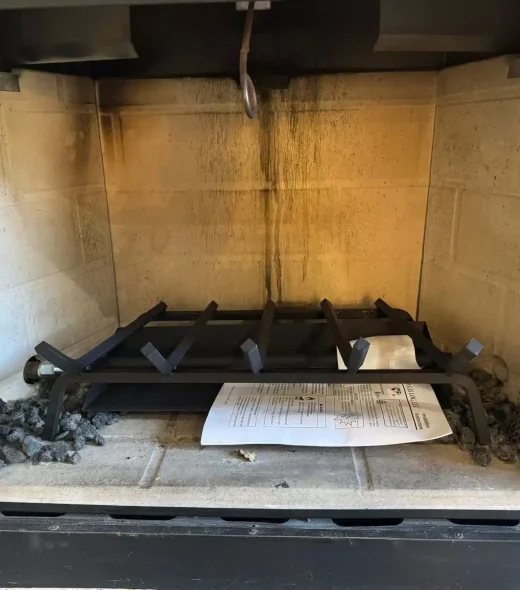
- Firebox brick inspection – firebox bricks face heat stress distinct from exterior brick; we assess both
- Waterproofing readiness check – confirms surface condition before penetrating sealer is applied
Match the Mortar, Replace the Course, Test the Joint - Every Time
Diagnostics
We begin with a thermal imaging scan and a full visual assessment. Every mortar joint is checked for depth, cracking, and separation. Every brick face is checked for spalling – that surface-layer shedding caused by freeze-thaw pressure – and for horizontal cracking that signals soil movement stress. We document before anything is removed.
Implementation
Replacement bricks are sourced to match the existing coursing – size, texture, and absorption rate. A mismatched brick absorbs water at a different rate than the surrounding courses, which accelerates failure at the repair boundary. Mortar is mixed to match the original formulation. We tuck new mortar into repointed joints in lifts, not all at once, to prevent shrinkage cracking as it cures. Brick courses are reset level and plumb.
Post-Service Testing
Once mortar has cured, joints are tested for bond integrity. The repaired surface is inspected for efflorescence development – any new mineral staining at this stage indicates remaining moisture pathways. A penetrating masonry water repellent is applied to the repaired zone. We document the completed repair with photographs so the homeowner has a baseline record for future assessments.
Pricing
Chimney Brick Repair Cost in Dallas
Typical price ranges for chimney brick repair across Dallas and the DFW Metroplex. Smaller, simpler jobs sit at the low end.
| Service | Typical price |
|---|---|
| Brick repair and restoration | $1,443 – $4,588 |
| Tuck-pointing or repointing mortar | $700 – $3,957 |
| Top brick courses rebuild2 to 4 courses | $2,892 – $7,055 |
| Chimney rebuild | $4,875 – $16,321 |
Your exact price is confirmed on site before any work starts. Smaller, simpler jobs sit at the low end of each range. Our $79 chimney safety inspection is waived when you book the repair.
Chimney Brick Repair Across Dallas, Garland, Richardson, Carrollton, and Irving
We cover the full Dallas-Fort Worth Metroplex – including neighborhoods where pre-1985 masonry chimneys are most concentrated. Our crews serve Dallas, Plano, Carrollton, Irving, McKinney, Frisco, Allen, Garland, Richardson, Addison, Arlington, and the surrounding DFW area. If your chimney is in the Metroplex and showing brick damage, we can get there.
Schedule Your Brick Assessment While the Damage Is Still Contained
Brick damage that starts small moves faster each season – an early assessment keeps the repair scope manageable.
Call us at 972-884-5553 or email info@theonechimneysweep.com to schedule your chimney brick repair assessment in Dallas. Tell us what you’re seeing – loose material, white staining, gaps in the mortar – and we’ll get a crew to your address. Same-week availability across the DFW Metroplex.
FAQ
What does chimney brick repair cost in Dallas?
Call 972-884-5553 for current rates. Cost depends on the number of courses affected, whether firebox bricks require separate attention, and how far moisture has migrated beyond the visible spalling zone. Thermal imaging confirms the actual damage boundary before any repair scope – and price – is finalized.
How long does a chimney brick repair take from thermal scan to finished seal?
Most brick repair projects are completed in one to two visits. The first visit covers thermal imaging, mortar joint probing, and full damage documentation. Repair work follows once the scope is confirmed. Repointing, brick replacement, and waterproofing sealer application happen in sequence – the sealer is applied last, after mortar cures, not the same day as brick replacement.
Why does thermal imaging matter before repairing spalling bricks?
Thermal imaging shows where moisture has already penetrated – not just where the surface has failed. Visible spalling trails the actual damage by one season or more. Repairing only what is visible can seal trapped moisture inside the wall. That moisture continues expanding through freeze-thaw cycles and fails the repair within two seasons.
Will the new mortar match my existing chimney, or will the repair look patched?
Mortar is matched to the original formulation – hardness, mix ratio, and color. Installing modern high-Portland mortar into an older Dallas chimney creates a rigidity mismatch. The new mortar won’t flex with clay soil movement, and the surrounding original bricks absorb that stress instead. Matching the mix protects the repair boundary and the adjacent courses.

Chimney repair is one of our main services.
We also offer a free home fire safety check at every service appointment.
Information
Service Areas
- Dallas
- Plano
- Carrollton
- Irving
- McKinney
- Frisco
- Allen
- Garland
- Richardson
- Addison
- Arlington
© 2024 – 2025 | All Rights reserved by The Chimney Inspection & Sweep
Powered By Rank First Labs