
Cracked Dallas Chimney Crown Assessed and Repaired Before the Next Rain
On-site structural evaluation determines repair vs. rebuild – sealant applied only to sound crowns.
Chimney Crown Repair in Dallas: Typical price $623 – $1,500
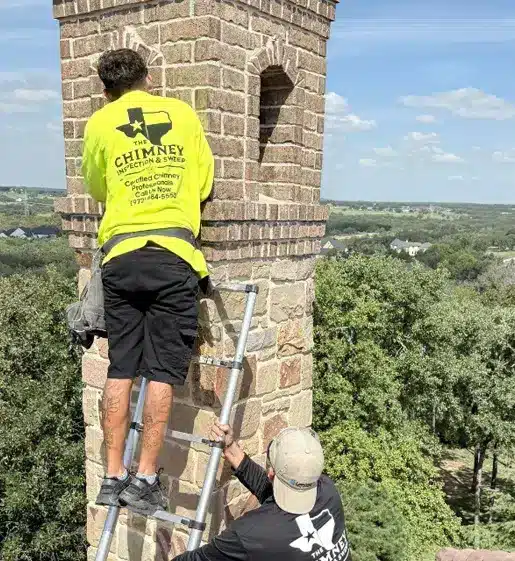
What Chimney Crown Repair Actually Covers
Chimney crown repair addresses the concrete cap at the top of your masonry chimney – before water finds a way through it.
The chimney crown is the sloped concrete or mortar cap poured across the top of a masonry chimney, surrounding the flue liner opening. Its job is simple: direct water away from the flue and prevent infiltration into the masonry below. When it fails, that job transfers to the brick and mortar underneath – and they are not built to handle it.
Repair scope depends on what the crown has actually lost. Surface cracks that haven’t reached the full depth of the crown are treated with elastomeric crown sealant – a flexible, waterproof coating that remains pliable through temperature cycling. A crown whose structure has failed, lost adequate overhang, or cracked through its full depth gets removed and rebuilt.
These are two different services. This page covers both.
Why Dallas Crowns Crack Faster Than Most Homeowners Expect
Dallas’s temperature range – sometimes 80-plus degrees across a single year – puts concrete chimney crowns through repeated expansion and contraction cycles.
Here’s what most homeowners don’t realize about chimney crown cracking in Dallas: the damage often starts in summer, not winter. July surface temperatures on a south-facing chimney crown can exceed the ambient air temperature by 30 degrees or more. Then January brings overnight freezes. That swing – compressing and expanding the concrete repeatedly – is what initiates surface cracks.
Spring rain fills those cracks. The water sits. It works its way into the masonry below the crown. By the time you notice water staining inside the firebox or efflorescence on the brick face, the crown has typically been failing for more than one season.
Chimney crown cracking in summer is a DFW-specific problem. The thermal expansion cycling that drives it doesn’t stop between repairs. That’s why the sealant material matters: an elastomeric sealant flexes with those cycles. A rigid patch compound re-cracks under the same conditions that opened the first crack.
What We Find on Dallas-Area Crown Calls
We get called to a cracked chimney crown in Dallas after a homeowner notices a wet firebox following a heavy rain. In many cases, someone patched that crown before – sometimes more than once. You can see the evidence: a layer of gray compound sitting over an older crack that has since re-opened beside it. The patch held for one season, maybe two.
When we’re on the roof, the first thing we check isn’t the surface condition. It’s the crown’s overhang. A properly formed crown extends at least 2 inches past the chimney’s brick face, with a downward-angled drip edge. Crowns built without adequate overhang let water run directly down the brick face below – and no sealant fixes that geometry.
On a recent call in Richardson, the crown looked repairable from the ground. Surface cracking, some spalling at the edges. On the roof, the overhang measured less than half an inch on the windward side. Water had been running straight down the brick face for years. The crack wasn’t the problem – the crown’s shape was. We rebuilt it.
That assessment happens before we open a tube of sealant. Always.
The Repair vs. Rebuild Question - Answered on Site
A sealant applied to a structurally failed crown doesn’t fix the problem – it delays the next service call.
We hear from homeowners who’ve had their crown sealed twice in three years and still have water getting in. That’s not a sealant failure. That’s the wrong service applied to the wrong diagnosis.
Here’s how we make the call. A crown that has surface cracking but intact structure, adequate overhang, and a functional drip edge is a sealant candidate. Elastomeric sealant applied to that crown absorbs into the surface, bridges hairline cracks, and remains flexible through DFW’s seasonal temperature swings.
A crown with through-depth cracks, inadequate overhang, flat profile, or compromised structural integrity gets rebuilt – not resealed. Sealing it would be applying a surface treatment to a substrate that can’t support it. The water migration path doesn’t change just because the surface looks coated.
That determination is made on-site, before any material is applied.
How Chimney Crown Repair Works - Start to Finish
Diagnostic Assessment
We start on the roof, not at the firebox.
The technician accesses the crown and measures overhang, checks slope, traces crack geometry, and assesses structural integrity. The flue collar clearance is inspected. Any prior repair material is evaluated. This assessment determines whether the crown is repairable or warrants a full rebuild.
The homeowner receives a clear recommendation – repair or rebuild – with the reason behind it. No sealant is opened until that determination is made and confirmed.
Implementation
Repair and rebuild are executed as separate scopes, never combined.
For elastomeric sealant repairs: the crown surface is cleaned of debris, loose material, and any prior rigid compound that has failed. Cracks are traced and pre-treated where depth requires it. The elastomeric sealant is applied in even coverage across the full crown surface, including the drip edge. Application rate is adjusted for DFW’s porous older crown material.
For full crown rebuilds: the failed crown is removed to the masonry substrate. A forming frame is set to specification – correct overhang, correct slope, correct flue collar clearance. The new crown is poured and finished. This scope connects directly to our Custom Concrete Crown Installation process.
Post-Service Confirmation
Before the crew leaves, the crown gets a final check.
Sealant coverage is confirmed across the full surface. There are no gaps at the drip edge or around the flue collar. The crew documents the completed crown with photographs. The homeowner receives a summary of what was found and what was done before we close the job.
Pricing
Chimney Crown Repair Cost in Dallas
Typical price ranges for chimney crown repair across Dallas and the DFW Metroplex. Smaller, simpler jobs sit at the low end.
| Service | Typical price |
|---|---|
| Crown seal or crack sealant | $759 – $1,360 |
| Crown repair | $623 – $1,500 |
| Crown or masonry cap replacement | $1,280 – $1,400 |
Your exact price is confirmed on site before any work starts. Smaller, simpler jobs sit at the low end of each range. Our $79 chimney safety inspection is waived when you book the repair.
Areas We Serve for Chimney Crown Repair
The Chimney Inspection & Sweep serves Dallas and the full DFW Metroplex for chimney crown repair.
We work across Dallas, Plano, Carrollton, Irving, McKinney, Frisco, Allen, Garland, Richardson, Addison, Arlington, and all surrounding communities. If you’re in the DFW area and your chimney crown needs attention, we can get a crew to you.
Schedule Your Dallas Chimney Crown Assessment
The crown assessment happens on-site – we tell you exactly what your crown needs before any work begins.
Call us at 972-884-5553 or email info@theonechimneysweep.com to schedule. With 12 active crews and 24/7 availability, we can typically get to you before the next rain window. We’ve been repairing and rebuilding Dallas-area chimney crowns since 1991. The assessment comes first. Every time.

Chimney repair is one of our main services.
We also offer a free home fire safety check at every service appointment.
Information
Service Areas
- Dallas
- Plano
- Carrollton
- Irving
- McKinney
- Frisco
- Allen
- Garland
- Richardson
- Addison
- Arlington
© 2024 – 2025 | All Rights reserved by The Chimney Inspection & Sweep
Powered By Rank First Labs