
Services
Chimney Inspection
What Happens to Dallas Chimney Mortar in Summer Heat
At The Chimney Inspection & Sweep, founded in 1991, we have documented how DFW's extreme summer heat accelerates chimney mortar joint damage at a rate significantly faster than cooler climates. With 12 active crews serving the Dallas area, we inspect hundreds of chimneys each fall and consistently find heat-driven mortar deterioration that homeowners never noticed over summer. This is not the whole list of our chimney mortar damage dallas summer heat services - read more on the home page or "services" dropdown menu.

How Dallas Summer Heat Destroys Chimney Mortar
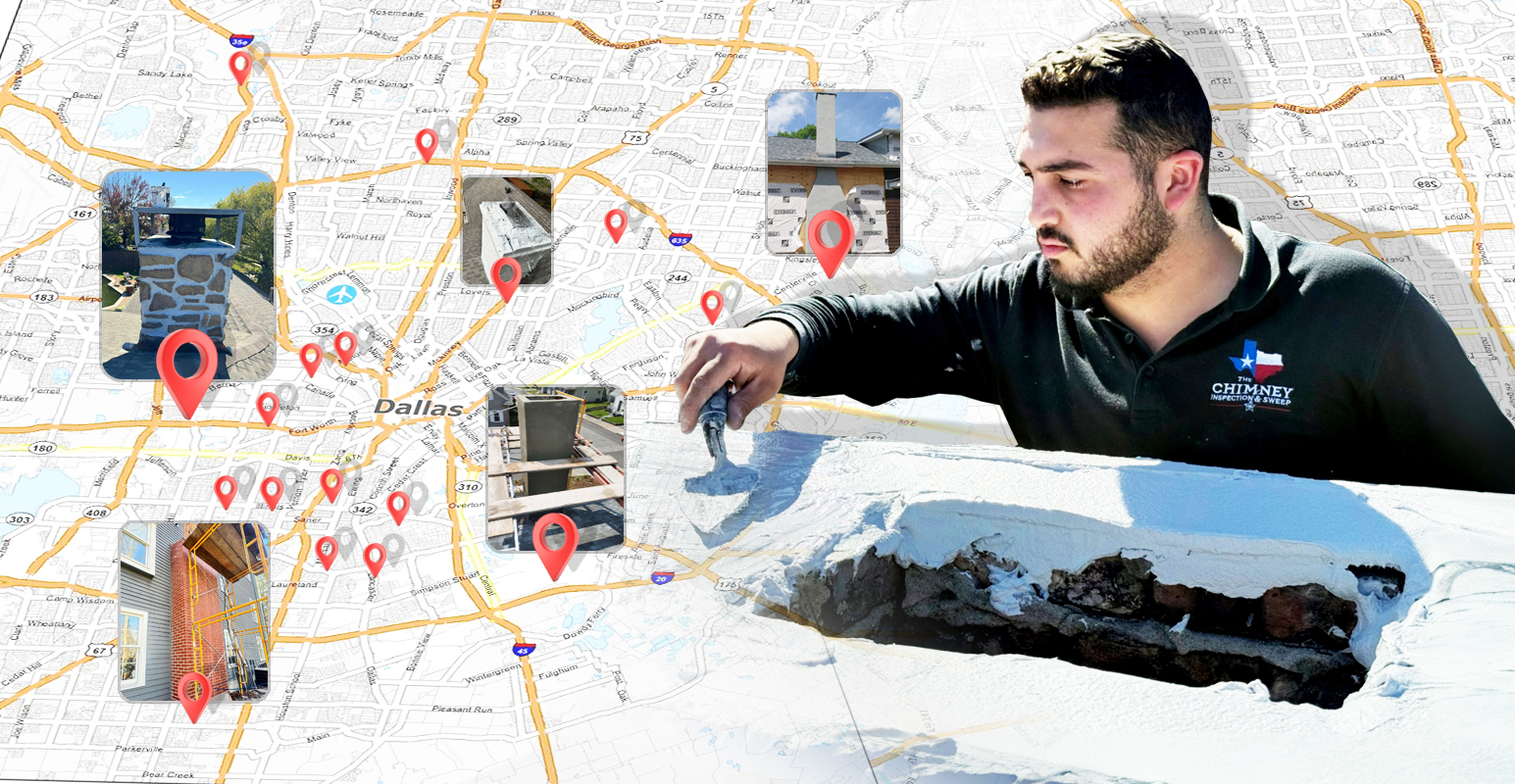
We are a chimney mortar inspection company serving Dallas-Fort Worth that has tracked heat-related masonry deterioration since 1991. DFW's climate subjects chimney mortar joints to sustained 100°F+ ambient temperatures combined with direct solar loading that can push exposed masonry surfaces well above 150°F. Unlike cooler northern climates where mortar primarily degrades through freeze-thaw cycling, Dallas chimneys face a distinct failure mechanism: rapid thermal expansion during the day followed by contraction overnight. This daily stress cycle, repeated across 90-plus days each summer, progressively fractures the cement matrix within mortar joints at a rate our crews consistently observe to be two to three times faster than chimneys in moderate climates.
Learn more about what is a chimney sweep →
Learn more about refractory fireplace panel replacement Dallas →
Learn more about what is a level 2 chimney inspection vs level 1 →
How Fast Does Heat Damage Chimney Mortar in DFW?
Mortar that is in good structural condition at the start of June can exhibit visible hairline cracking by late August after a single DFW summer. The critical variable is the mortar's original mix specification: Type N mortar, commonly used in residential chimneys, has a lower compressive strength and performs poorly under sustained thermal loading. Type S mortar handles heat stress better, but even correctly specified joints begin spalling - meaning the mortar face separates and falls away in thin layers - after three to five years of unmitigated Dallas summer exposure without any protective sealant applied.
The deterioration timeline accelerates significantly when previous hairline cracks allow moisture infiltration. Even minor summer thunderstorm moisture penetrating a 1mm crack will expand the fracture plane when temperatures spike the following day, advancing weeks of normal degradation within a single heat cycle.
Spotting Early Mortar Damage: Hairline Cracks vs. Active Water Intrusion
Distinguishing early-stage from advanced mortar damage is a core competency our 33 years of operation have refined. Hairline cracking presents as thin, surface-level fractures running horizontally along mortar joints, typically less than 0.5mm wide, with no loose or missing material. At this stage the structural bond between brick courses remains intact. These cracks are detectable during a close visual inspection from the roofline and represent a tuckpointing opportunity before deeper degradation occurs.
Active water intrusion presents differently. Staining patterns - white efflorescence deposits on brick faces, dark moisture shadows on interior firebox walls, or rust streaking from embedded metal ties - all indicate that water has already migrated through compromised joint depth. At this stage, professional chimney mortar leak reporting and a documented assessment are essential to quantify penetration depth before fall rain season compounds the damage. The Chimney Inspection & Sweep provides precisely this six-point safety review as part of every mortar evaluation visit.
What Dallas Homeowners Can Check From the Ground
From ground level using binoculars, scan the mortar joints at the chimney crown and the top two courses of brick - these receive maximum solar exposure and show heat-related spalling first. Look for recessed joint faces where mortar has eroded more than 6mm below the brick face, crumbling material at joint edges, and any brick displacement indicating structural joint failure. Debris accumulation at the chimney base - small fragments of mortar grit - is a reliable indicator that active spalling occurred over summer. Any of these observations warrant scheduling a fall inspection before the first significant North Texas rain event.
Tuckpointing vs. Full Mortar Replacement: Which Does Your Dallas Chimney Need?
The distinction between tuckpointing and full mortar replacement is one of the most consequential repair decisions a Dallas homeowner faces after a summer heat evaluation. Tuckpointing is the correct procedure when existing mortar has surface deterioration but retains structural integrity at depth - typically when joint erosion is less than 25mm deep. Our technicians mechanically cut degraded material to a minimum depth of 19mm, remove all debris, and pack new mortar in lifts to match the original joint profile, ensuring full bond with the surrounding masonry.
When Full Mortar Replacement Is Required
Full mortar replacement becomes necessary when heat-driven spalling has compromised the full joint depth, when water intrusion has caused brick face delamination, or when multiple summer seasons of deferred maintenance have left joints voids exceeding 50% of their original profile. In these cases, tuckpointing will not provide adequate structural restoration - the deteriorated substrate cannot support a new mortar bond. Full replacement involves complete joint excavation, brick realignment where displacement has occurred, and rebuilding with a mortar specification matched to the DFW thermal environment.
Our crews document each repair scope with photographic condition reports before and after work, establishing a maintenance record that informs future fall inspection intervals. For Dallas chimneys exposed to sustained chimney mortar damage from summer heat, we typically recommend a post-summer inspection on a two-year cycle at minimum, or annually for chimneys over 20 years old.
Why Fall Is the Critical Inspection Window for Dallas Chimneys
The Chimney Inspection & Sweep provides chimney inspection services calibrated specifically to the DFW seasonal cycle. Fall - September through November - represents the narrowest and most consequential intervention window for Dallas chimneys. Summer heat has completed its maximum damage load on mortar joints, but the heavy North Texas rain season has not yet arrived in force. Mortar joints compromised by summer thermal cycling are structurally open and will channel rainwater directly into the chimney's masonry core once autumn storms begin, causing damage that far exceeds the original heat-related deterioration.
Our inspection process includes a systematic visual review of all mortar joint courses, crown condition assessment, flashing seal integrity verification, and technical analysis of any staining patterns indicating prior moisture migration. Every element is documented, producing a condition report that clearly distinguishes cosmetic from structural findings and prioritizes repairs by urgency before rain season onset.
Additional deliverables include mortar specification recommendations and a repair timeline matched to current weather windows for proper mortar cure.
Mortar Damage Indicators Our Fall Inspection Commonly Identifies
Our fall post-summer evaluations routinely document a consistent set of heat-driven findings: spalled mortar joint faces in the upper chimney courses, hairline cracking at brick-to-mortar interfaces, crown surface fracturing that channels water into the flue chase, and efflorescence deposits indicating earlier moisture infiltration through compromised joints. In older DFW structures, we frequently identify mortar joint voids at the firebox throat that result from combined heat exposure - both summer ambient temperatures above and combustion heat below. Each finding is categorized by severity and repair method in our written condition report, giving homeowners a precise, actionable scope rather than a generic maintenance recommendation. Addressing these issues in fall eliminates the compounding damage cycle that defines deferred chimney mortar maintenance in the Dallas climate.
Mortar Repair and Protective Treatments | Dallas
Following mortar joint repair, The Chimney Inspection & Sweep applies penetrating masonry sealants rated for high-temperature exterior exposure, specifically formulated to accommodate the thermal expansion rates documented in DFW summer conditions. These sealants allow moisture vapor transmission - preventing trapped moisture pressure from within the masonry - while blocking liquid water penetration. For chimneys where summer heat has also damaged the crown, we apply a flexible elastomeric crown coat that bridges existing hairline fractures and resists further thermal cycling. Our mortar repair and protective treatment process is performed in a sequenced protocol to ensure each layer cures properly before the next is applied, a procedural discipline our 33 years of operation have established as standard for Dallas-area masonry longevity.
Chimney Crown and Flashing Assessment
The chimney crown is the first component to display heat-related cracking because it is a solid concrete or mortar slab with no brick joints to absorb differential expansion stress. Dallas summer temperatures cause the crown to expand and contract as a monolithic unit, generating tension fractures that run parallel to the flue opening. Our crews evaluate crown crack width, depth, and pattern during every fall inspection to determine whether elastomeric sealing is sufficient or structural crown replacement is required.
Flashing at the chimney-to-roof interface is simultaneously assessed for thermal gap opening - a condition where repeated expansion cycles have separated the step flashing from the counter-flashing channel, creating a direct water intrusion path that becomes active with the first significant autumn rainfall. Our technicians re-bed and re-seal separated flashing sections using high-temperature, flexible roofing sealant rated for DFW thermal cycling ranges, restoring a continuous moisture barrier before rain season onset. This combined crown-and-flashing evaluation is a standard component of our post-summer mortar damage assessment protocol.
Schedule Your Post-Summer Mortar Inspection | Dallas
The Chimney Inspection & Sweep has operated 12 active crews across the DFW area since 1991, giving us the capacity and scheduling depth to complete fall mortar assessments before the rain season window closes. Our post-summer mortar inspection is a structured, documented process - not a generalized walkthrough. Each visit produces a written condition report with photographic documentation, joint depth measurements, mortar specification recommendations, and a prioritized repair scope distinguishing tuckpointing candidates from full replacement requirements.
Dallas chimneys face a uniquely demanding thermal environment. The combination of sustained 100°F+ summer cycles, DFW clay soil movement affecting structural loading, and the sharp transition to wet autumn conditions creates a compounding damage sequence that rewards early detection. Our inspection and repair protocols are specifically calibrated to this local environment, not adapted from generic national standards developed for cooler or freeze-thaw climates.
Our technicians evaluate every mortar joint course, crown surface, flashing seal, and firebox throat connection as part of a comprehensive six-point safety review, then deliver findings in plain language with clear repair recommendations and cost parameters.
Contact Us to Schedule a Mortar Damage Assessment
If your Dallas chimney has not been evaluated since spring, contact us before fall rains arrive. We provide free estimates and same-day callback!
EXCELLENTTrustindex verifies that the original source of the review is Google. Happy with my chimney cleaning.Posted on GoogleTrustindex verifies that the original source of the review is Google. Happy with my chimney cleaning.Posted on GoogleTrustindex verifies that the original source of the review is Google. Koran was fabulous! Let me know when he would arrive and did a great job! Would definitely use them again.Posted on GoogleTrustindex verifies that the original source of the review is Google. Koran was fabulous! Let me know when he would arrive and did a great job! Would definitely use them again.Posted on GoogleTrustindex verifies that the original source of the review is Google. Liran is a very professional and knowledgeable technician! I'm so grateful his company'( The Chimney Inspector & Sweep) came out on a Sunday afternoon to inspect my gas log fireplace. A great big "Thank You" to Liran for his sound instructions and, of course, his patience in teaching me how to confidently operate my fireplace after 12 years. Please make The Chimney Inspectors & Sweep your "go-to" company before it gets cold!! I know I will future forward! It was an outstanding customer experience!! 🤗Posted on GoogleTrustindex verifies that the original source of the review is Google. Liran is a very professional and knowledgeable technician! I'm so grateful his company'( The Chimney Inspector & Sweep) came out on a Sunday afternoon to inspect my gas log fireplace. A great big "Thank You" to Liran for his sound instructions and, of course, his patience in teaching me how to confidently operate my fireplace after 12 years. Please make The Chimney Inspectors & Sweep your "go-to" company before it gets cold!! I know I will future forward! It was an outstanding customer experience!! 🤗Posted on GoogleTrustindex verifies that the original source of the review is Google. Will recommend!!Posted on GoogleTrustindex verifies that the original source of the review is Google. Will recommend!!Posted on GoogleTrustindex verifies that the original source of the review is Google. Great service !!!Posted on GoogleTrustindex verifies that the original source of the review is Google. Great service !!!
Request a Free Quote | Same-day Callback!

Chimney repair is one of our main services.
We also offer a free home fire safety check at every service appointment.
Information
Service Areas
- Dallas
- Plano
- Carrollton
- Irving
- McKinney
- Frisco
- Allen
- Garland
- Richardson
- Addison
- Arlington

Chimney repair is one of our main services.
We also offer a free home fire safety check at every service appointment.
Information
Service Areas
- Dallas
- Plano
- Carrollton
- Irving
- McKinney
- Frisco
- Allen
- Garland
- Richardson
- Addison
- Arlington
© 2024 – 2025 | All Rights reserved by The Chimney Inspection & Sweep
Powered By Rank First Labs